

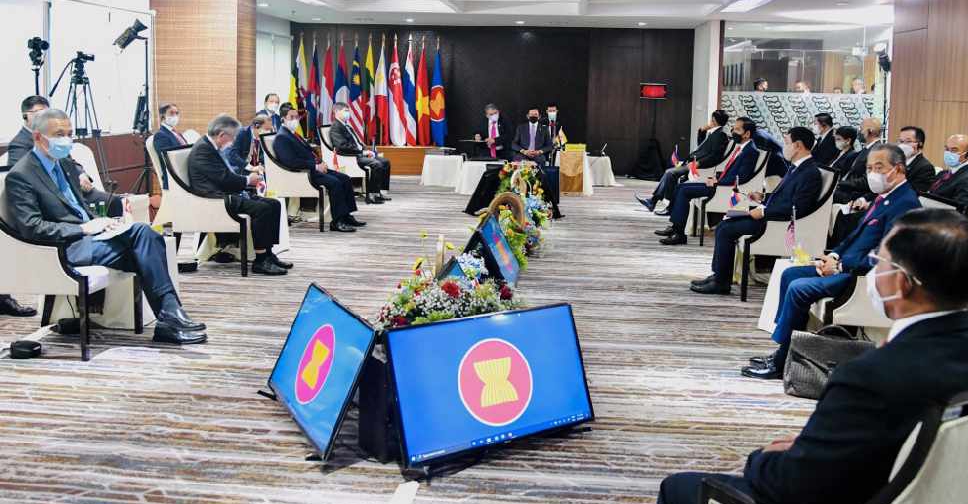
Southeast Asian leaders said they had agreed on a plan with Myanmar's junta chief on Saturday to end the crisis in the violence-hit nation.
It paves the way for halting the killing of civilian protesters and accepting humanitarian assistance.
"It's beyond our expectation," Malaysian Prime Minister Muhyiddin Yassin told reporters after the leaders' meeting of the Association of Southeast Asian Nations (ASEAN).
ASEAN leaders wanted a commitment from Senior General Min Aung Hlaing to restrain his security forces, who monitors say have killed 745 people since a mass civil disobedience movement emerged to challenge his February 1 coup against the elected government of Aung San Suu Kyi.
They had also wanted the release of political prisoners.
"It's good that he did not reject what was put forward by me and many other colleagues," Muhyiddin said of the general, who was at the meeting with the other leaders.
According to a statement from Brunei, the chair of the group, a consensus was reached on five points - ending violence, a constructive dialogue among all parties, a special ASEAN envoy to facilitate the dialogue, acceptance of aid and a visit by the envoy to Myanmar.
"He said he heard us, he would take the points in, which he considered helpful," said Singapore Prime Minister Lee Hsien Loong of the junta chief, according to Channel NewsAsia television.
"He was not opposed to ASEAN playing a constructive role, or an ASEAN delegation visit, or humanitarian assistance."
But Lee added the process had a long way to go, "because there's one thing to say you'll cease violence and release political prisoners; it's another thing to get it done."
There was no immediate comment from Min Aung Hlaing.
The ASEAN gathering in Jakarta was the first coordinated international effort to ease the crisis in Myanmar, an impoverished country that neighbours China, India and Thailand. Myanmar is part of the 10-nation ASEAN.
The bloc has a policy of consensus decision-making and non-interference in the affairs of its members.
It was unusual for the leader of a military government in Myanmar to attend an ASEAN summit - usually the country has been represented by a lower-ranked officer or a civilian.
The leaders of Indonesia, Vietnam, Singapore, Malaysia, Cambodia and Brunei were at the meeting, along with the foreign ministers of Laos, Thailand and the Philippines.
While ASEAN's policy of non-interference makes it difficult to tackle contentious issues, the body is seen by the United Nations, China and the United States as best placed to deal with the junta directly.
"We in the [@UN] Security Council eagerly await the outcome of the @ASEAN meeting on Burma, which deserves serious and immediate attention," said U.S Ambassador to the United Nations Linda Thomas-Greenfield on Twitter.
Still, some analysts warned of the dangers of giving legitimacy to the junta by inviting its leader to the summit.


 Reopening of Gaza's Rafah crossing expected Monday
 Winter storm death toll in United States reaches 90
 Pakistan says 145 militants killed after attacks in Balochistan
 Israeli strikes kill 26 in Gaza, health officials say