

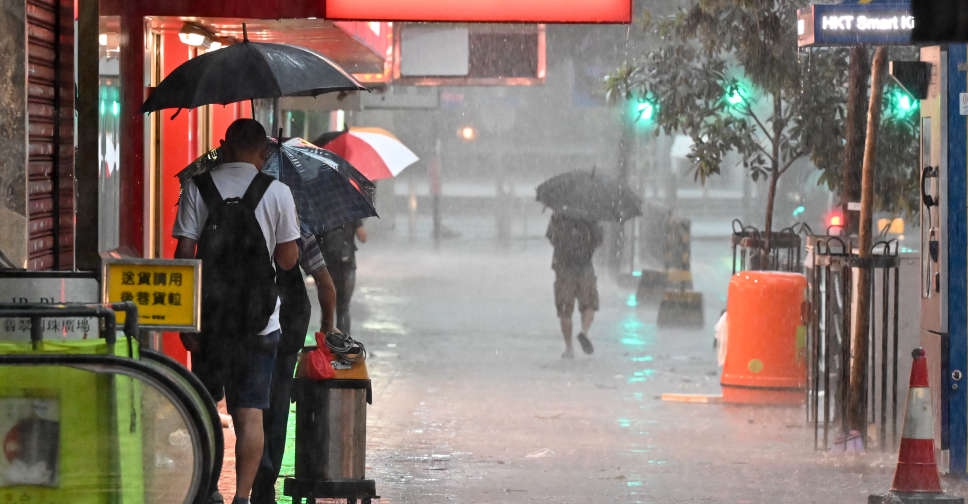
Residual rains from former typhoon Haikui, now a tropical storm, drenched southern China for the seventh day as slow-moving storm clouds drifted from Guangdong on the coast to Guangxi, flooding low-lying areas, blocking roads and trapping residents.
In the rural county of Bobai in Guangxi region, rescuers on assault boats have scrambled to pull people to safety since Sunday night as water more than 2 metres deep stranded residents in low-rise homes, state media reported on Monday.
In hillier areas, landslides destroyed roads and bridges collapsed. At one weather station in Bobai, local records were shattered when rainfall reached 511.2 mm, more than a quarter of the region's annual precipitation.
Haikui has weakened from a typhoon to a tropical storm since making landfall in Fujian province on Sept. 5, but its residual vortex has continued to wreak havoc in southern China, with the populous city of Shenzhen deluged by the heaviest rain since records began in 1952. Neighbouring Hong Kong was pelted by the worst storm in 140 years.
Scientists warn that typhoons hitting China are becoming more intense and their paths growing more complex, escalating risk of disaster, even in coastal cities such as Shenzhen that regularly brave tropical cyclones and already have strong flood defence capabilities.
"Typhoons that move far inland affect regions historically less exposed to heavy rainfall and strong wind, often with lower disaster resilience, leading to more severe losses," said Shao Sun, a climatologist at the University of California, Irvine.
"In this case of Shenzhen, the disaster was mainly due to the slow westward movement of Haikui's residual circulation, which nearly stagnated in its spatial position from the afternoon of September 7 to the early hours of September 8, and a "train effect" of heavy rainfall occurred, causing the event to exceed its expected intensity.
A so-called "train effect" refers to the cumulative effect of multiple convective cloud systems passing over an area in succession, resulting in a significant accumulation of rainfall accumulation and sharply raising the potential for heavy or even extreme rainfall.
Heavy rain is expected to persist in Guangxi over the next few days.
In other parts of China, late summer rains have tested the ability of sprawling urban centres.
The streets of Xian, a northwestern city with a population of around 13 million, were quickly under water on Monday. Videos on social media showed cars and motorbikes being dragged away by fast-running floodwaters.
Breakneck urbanisation in China has encased vast stretches of land in impermeable concrete, often along the banks of major rivers, that traditionally served as flood plains.
According to 2018 data, 641 out of 654 large- and medium-sized cities in China were prone to flooding and waterlogging, with 180 facing flood risks each year.


 Reopening of Gaza's Rafah crossing expected Monday
 Winter storm death toll in United States reaches 90
 Pakistan says 145 militants killed after attacks in Balochistan
 Israeli strikes kill 26 in Gaza, health officials say