
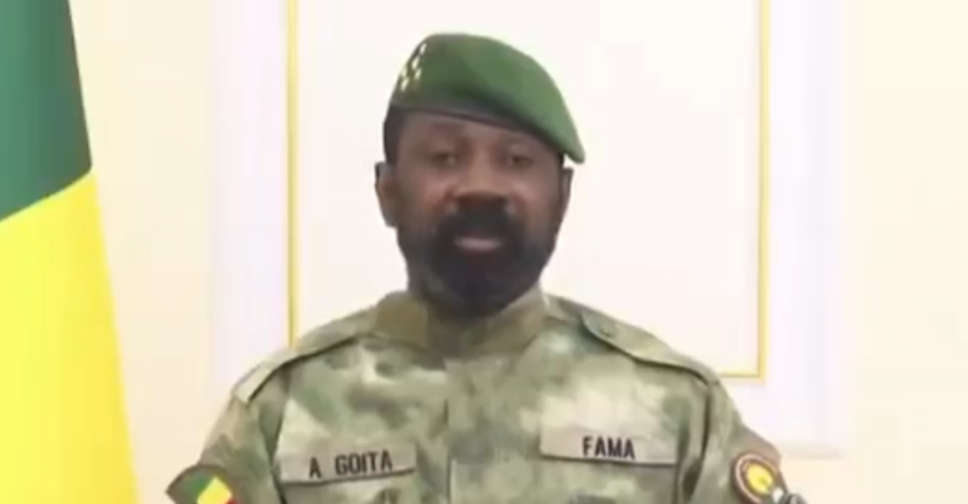
The leader of Mali's military government, Assimi Goita, has made his first public appearance on Tuesday since insurgents launched coordinated attacks over the weekend, vowing in a televised address to "neutralise" those responsible.
West Africa's al Qaeda affiliate and a Tuareg-dominated separatist group hit Mali's main army base and the area near Bamako's airport in the attacks on Saturday, while also pushing Russian troops supporting government forces out of the strategic town of Kidal in the north.
The attacks have triggered a scramble for territory across Mali's vast desert north, raising the prospect of significant gains by armed groups that have shown an increasing willingness to strike neighbouring countries and, analysts say, could eventually set their sights further afield.
DEFENCE MINISTER KILLED
Mali's defence minister, Sadio Camara, was killed in Saturday's attacks. Goita had not been seen until his office on Tuesday afternoon published pictures of him meeting the Russian ambassador, Igor Gromyko.
The two men "discussed the current situation and the strong partnership between Bamako and Moscow", and Gromyko "reaffirmed his country's commitment to supporting Mali in the fight against international terrorism," a social media post from Goita's office said.
Goita also visited a hospital where people wounded in Saturday's attacks were receiving treatment, and expressed condolences to Camara's family, his office said.
He then delivered a brief address on the evening news in which he declared that "the situation is under control" and said operations would continue until they achieved "the complete neutralisation of the groups involved" in the attacks.
The scale of the offensive, which hit multiple sites across the West African country, demonstrated an unprecedented ability by groups with differing objectives to work together and strike at the heart of the military government.
REBELS THREATEN SIEGE OF CAPITAL
In a video message distributed on Tuesday, a spokesperson for the al Qaeda affiliate, Jama'at Nusrat al-Islam wal-Muslimin (JNIM), boasted about Saturday's violence and described it as revenge for drone strikes and other attacks perpetrated by Malian forces.
The spokesperson, Bina Diarra, also threatened to implement a siege of Bamako, a city of 4 million people.
"As of today, Bamako is closed off from all sides," he said in the message.
JNIM imposed a fuel blockade of Bamako last year, but it had eased in the period leading up to Saturday's attacks.
RUSSIA SAYS INSURGENTS REGROUPING
Russia said on Tuesday that forces in Mali were regrouping after Moscow's forces helped thwart what it described as a coup attempt on Saturday, preventing insurgents from seizing key facilities, including the presidential palace.
"The enemy has not abandoned its aggressive intentions and is currently regrouping," the Russian Defence Ministry said in a statement.
Russian forces were conducting active reconnaissance operations to destroy insurgent field camps and stood ready to repel further attacks, it added.
Moscow's response to the attacks is being closely watched across the continent and beyond at a time when its forces are tied down fighting in Ukraine, and it is trying to deepen its role as a security guarantor to friendly resource-rich governments in Africa.
Mali turned to Russia for support after expelling French and UN troops following coups in 2020 and 2021.

 UN rights chief says uncovered remains in Gaza raise concerns of war crimes
 Indian police to query Google over 500,000 fake Gmail IDs linked to bomb hoax
 Saudi Arabia says danger passed in six cities, including Yanbu
 Bahrain, Kuwait, Jordan offer condolences over martyrdom of two UAE servicemen