
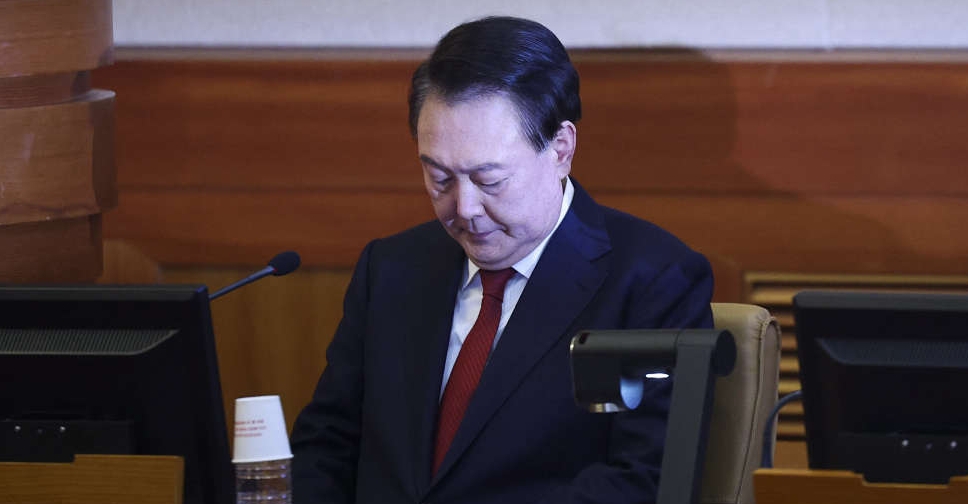
South Korean President Yoon Suk Yeol attended on Tuesday a Constitutional Court hearing of his impeachment trial where he denied ordering military commanders to drag lawmakers out of parliament during his short-lived bid to impose martial law.
Near the start of the hearing, Yoon said he had worked in public service with "a firm commitment to free democracy", when invited by the acting chief justice, Moon Hyung-bae, to speak.
Dressed in a navy-coloured suit with a burgundy tie, Yoon, a career prosecutor before his 2022 election as president, pledged to answer any questions the court might have.
Yoon has been incarcerated since last week under a separate criminal probe on charges of leading an insurrection with his attempt to impose martial law in early December, a move that shocked the nation and was overturned within hours by parliament.
Yoon told the hearing that special forces troops sent to parliament on Dec. 3 were not there to disable the legislature or prevent it from blocking his martial law because he knew such an action would have led to an indefensible crisis.
"In this country, parliament and news media are far more powerful than the president, in a far superior position," he told the court.
His lawyers outlined arguments in defence of Yoon's martial law declaration, saying it was meant to sound the alarm over abuses committed by the opposition Democratic Party.
They argued the opposition's actions had paralysed government and pushed the country's democratic and constitutional order to the brink of collapse.
"The decree was intended simply to establish the format of martial law and never intended to be executed, nor was it possible to execute it because of the potential for conflict with higher-level laws," lawyer Cha Gi-hwan told the court.
Cha also denied testimony by military commanders involved in the martial law declaration who said Yoon and his top aides ordered the arrest of some members of parliament who had politically clashed with the president.
The opposition Democratic Party, joined by minority parties and also 12 members of Yoon's People Power Party, voted with a two-thirds majority to impeach Yoon on December 14.
HELICOPTERS LANDING AT PARLIAMENT
The Constitutional Court began the trial on December 27 to review an impeachment motion that accused Yoon of violating his constitutional duty by imposing martial law with no justifiable grounds.
The parliament's legal team presented testimony from military commanders and video footage showing military helicopters landing on parliament grounds with special forces troops breaking into the main building, as well as troops moving in on the National Election Commission.
One of the lawyers also criticised unproven claims of irregularities at the election commission, which Yoon cited as a factor for justifying martial law.
"In South Korea's current national chaos, the conspiracy theory of election fraud can destroy our community itself," said the lawyer.
The Constitutional Court has up to 180 days to decide whether to remove Yoon from office permanently or reinstate him.
Yoon was driven to the hearing from the Seoul Detention Centre, where he is being held, in a correctional service vehicle escorted by a Presidential Security Service motorcade.
He was permitted to change from the khaki prison uniform he currently has to wear.
After the hearing, Yoon visited a medical facility to receive medical attention with prior authorization from the head of the detention centre, the Justice Ministry which oversees correctional service said in a statement.
It did not provide further details on privacy grounds.
Yoon's decision to attend the impeachment hearing contrasts with his vigorous resistance to criminal proceedings against him where he has refused to answer summons by investigators or attend interrogation sessions.
Yoon's legal team has denied he masterminded an insurrection, a crime in South Korea punishable by life imprisonment or even technically by the death penalty.
Security was heightened at the Constitutional Court on Tuesday, after a mob of angry Yoon supporters went on a rampage through the district court that issued a warrant to extend his detention early on Sunday.
Dozens of police buses were lined bumper-to-bumper on both sides of the street, keeping hundreds of Yoon supporters more than 100 metres (109 yards) away from the court.

 Israeli strikes kill 15 in Gaza, minister says no deal to halt attacks
 Death toll from migrant rush into Ceuta rises to 72
 Ukrainian drones kill eight in Russia
 Two helicopters collide as Greece battles wildfires