
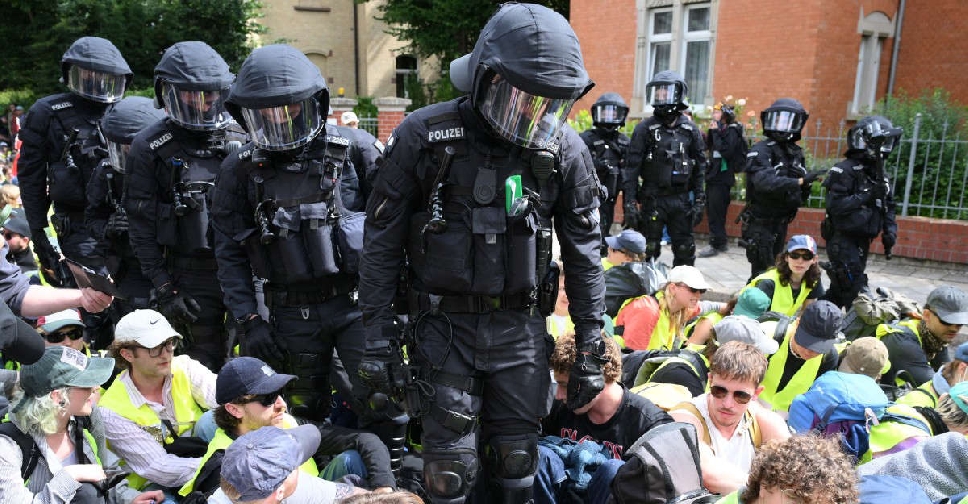
Thousands protested against Germany's far-right AfD and blocked roads to its annual conference in the eastern city of Erfurt on Saturday, where the party re-elected the two leaders who have overseen its rise as a national force.
Protesters from unions, civil society groups and left-wing parties gathered as large numbers of police, including reinforcements from across Germany, were deployed ahead of the AfD's two-day conference. AfD stands for Alternative for Germany.
Watched by police in riot gear, protesters sat in rows to block highways and roads leading to the convention centre where the meeting is being held.
Police estimated around 15,000 people joined demonstrations in and around the eastern city.
The AfD launched the event by re-electing party chiefs Alice Weidel and Tino Chrupalla, under whose leadership the AfD has surged to the top of national opinion polls ahead of Chancellor Friedrich Merz's conservatives.
The opening speeches mocked and lambasted the protesters as anti-democratic.
They revelled in the AfD's rise that could see the party taking power in regional elections this year for the first time, while painting their mainstream rivals as tired, out of touch and leading Germany into decline.
"For this remains our last chance to save our country," Weidel said. "More and more people in this country want to support us in the fight against Germany's decline, in the fight for our fatherland and for our identity."
Underscoring the party's hard line on immigration, a song called "Send them back" played on the AfD's social media stream minutes before the convention opened.
Inside the convention centre, vintage-style cards were on sale with slogans such as "YOU will be deported".
Bjoern Hoecke, seen as one of the party's most radical and controversial leaders, offered a mix of nostalgia and invective, even pointing to the state of Germany's motorway toilets as an example of national malaise.
"A great Germany is a Germany where one need not fear taking a walk through the city park in the evening. A great Germany is a country where apartment keys can be left hanging on the outside of the door," he said.
LEADING IN THE POLLS
The conference comes ahead of elections in the eastern states of Saxony-Anhalt and Mecklenburg-Vorpommern in September that the AfD hopes will help pave the way for success at national level.
"We will govern. First at a regional level, then at national level," Chrupalla told the conference in a speech that sought to stress party unity.
Both Chrupalla, a trained painter and varnisher from the eastern state of Saxony, and Weidel, a former Goldman Sachs analyst from western Germany, were re-elected with no opposition, but Chrupalla's score of 70% was well below the 81% he secured at the last vote two years ago.
A proponent of halting military aid to Ukraine, Chrupalla has called for a reset in relations between Berlin and Moscow, which have become openly hostile over the war in Ukraine.
Formed more than a decade ago, the AfD has deployed a mix of nationalist rhetoric, calls for tougher immigration policies and appeals to voters frustrated with successive governments and years of economic stagnation.
"Criminals and illegal migrants have no place in Germany any more," Weidel said. "We will deport them rigorously, because our country deserves better."
Opponents accuse the AfD of promoting racist policies and attitudes incompatible with Germany's democratic values, and say it would threaten the country's constitutional order.
Mainstream parties have ruled out any cooperation, under a so-called 'firewall' strategy designed to isolate the party and keep it out of coalition governments.
AfD leaders deny opposing Germany's democratic foundations and earlier this year won a court injunction ordering the domestic intelligence service to suspend a previous classification of the party as 'extremist'.
Recent polls put AfD support as high as 29 per cent, compared with around 22 per cent for Merz's CDU/CSU conservatives.
Its strongest support comes from the former communist east, where surveys show the highest levels of voter disillusionment with the traditional party system.

 UN rights chief says uncovered remains in Gaza raise concerns of war crimes
 Italian NATO jet downs suspected Russian drone over Lithuania
 Indian police to query Google over 500,000 fake Gmail IDs linked to bomb hoax
 Saudi Arabia says danger passed in six cities, including Yanbu