
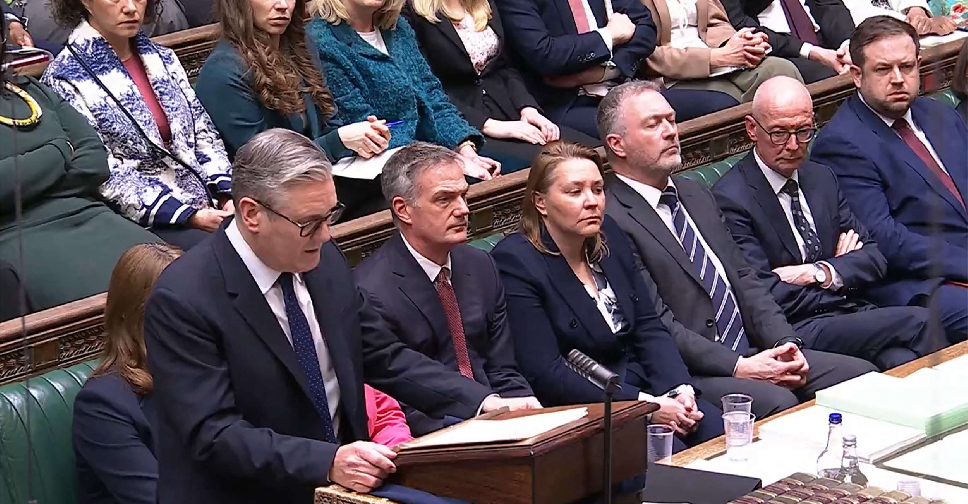
British Prime Minister Keir Starmer put the blame firmly on foreign ministry officials on Monday over the appointment of a US ambassador, saying they had withheld information about Labour veteran Peter Mandelson that would have halted his employment.
Starmer, under pressure to resign by political opponents over the scandal, has repeatedly sought to defend his role in the appointment of Mandelson and turned to parliament to set out his case that he was unaware that foreign ministry officials had been advised not to give security clearance to him.
He again said he regretted appointing Mandelson, whom he sacked in September after revelations about the depth of his ties to the late Jeffrey Epstein.
The events have prompted questions about the prime minister's judgment, which resurfaced when the government said last week it had just found out Mandelson had failed a security vetting process.
On Monday, Starmer again expressed his anger over not being told by foreign ministry officials that in January 2025 they had disregarded advice and decided to grant Mandelson what is known as "developed vetting" clearance, a status that allows individuals access to information regarded as top secret.
"It beggars belief that throughout the whole timeline of events, officials in the foreign office saw fit to withhold this information from the most senior ministers in our system in government," Starmer told parliament.
"That is not how the vast majority of people in this country expect politics, government or accountability to work."
An appointment that once was hailed as a stroke of genius for employing a Labour veteran with trade experience who could win over incoming US President Donald Trump has turned out to be an ongoing nightmare for Starmer.
Starmer said he would not have appointed Mandelson if he had known the UK Security Vetting unit had advised that he should not gain the necessary clearance and that he had stopped the foreign office from being able to go against such advice in future.
Starmer, whose popularity has sunk since he won a landslide majority for Labour at a national election in 2024, had previously told parliament all due process had been followed over Mandelson.
Earlier, his spokesperson said: "The PM would never knowingly mislead parliament or the public ... He clearly did not have this information when he previously spoke to parliament."
After last week's revelations that the foreign office had overridden a warning Mandelson should not be appointed, Starmer sacked Olly Robbins, Britain's top foreign ministry official, who the prime minister said had signed off on a statement on Mandelson clearing the vetting process.
Robbins has yet to make a formal statement on his sacking, but friends of his have been reported as saying he had followed the usual procedure, which allowed the foreign office to overrule advice from UK Security Vetting.
Opponents have accused Starmer of lying and incompetence, and say his position is no longer tenable.
Three weeks before local elections in which Labour is expected to suffer heavy losses, the resurgence of the scandal has triggered new questions about Starmer's grip on government, although no senior Labour lawmakers have urged him to go.
Kemi Badenoch, leader of the main opposition Conservative Party, accused Starmer of failing to face up to the consequences of his action.
"It is how you face up to those mistakes that shows the character of a leader," she told parliament.
"Instead of taking responsibility for the decisions he made, the prime minister has thrown his staff, and his officials, under the bus."

 Israeli strikes kill 15 in Gaza, minister says no deal to halt attacks
 Death toll from migrant rush into Ceuta rises to 72
 Ukrainian drones kill eight in Russia
 Two helicopters collide as Greece battles wildfires